


Have You Thanked a Bird Today?


There are many reasons why we should be thankful for birds. They provide a wide variety of ‘services’ that benefit people and the environment. Here are just a few examples:
They provide pest control.

Modern history is filled with stories of birds saving potato fields, fruit orchards, and cranberry bogs from insect devastation. Probably the most famous is the gulls eating locust to save Morman crops in Utah. Now researchers are studying the phenomenon more closely, trying to quantify birds’ value as living pest controllers.
They clean up.

Perhaps the least sexy service birds provide is eating dead bodies. New world vultures in particular take about 12 million tons of CO2 out of the atmosphere. According to EPA that is would equivalent to taking 2.6 million cars off the road each year. Unfortunately, the vulture populations worldwide have suffered major declines. In many cases the cause can be traced back to indirect poisoning resulting from drugs given to animals the vultures feed on. Researchers have also found a direct link between the decline in vultures to increase diseases.
They spread seeds.

In the high mountains of the American west, the future of the whitebark pine forests hangs in the beak of a particular bird. The Clark’s Nutcracker is the sole distributor of the seeds of this tree. The nutcracker’s use their long, sturdy bill to open the pinecones and pluck out the seeds. Seeds the bird doesn’t eat immediately are buried for later use. Those seeds not retrieved and eaten grow into new trees. Without the nutcracker, it’s unlikely the whitebark pine would be able to sustain itself. The U.S. Forest Service figures the nutcracker’s dispersal service is worth between $800 - $1,000 per acre, the cost to plant the trees by hand. Multiply that by 14.3 acres and you get a savings of more than $11 billion in the U.S. alone.
Many other birds disperse seeds through their digestive system. The eat the fruit of a tree or bush, then deposit the inedible seed elsewhere in the environment.
They are bellwethers.

Most of us re familiar with the book Silent Spring, Rachel Carson’s 1962 book, which chronicled the lethal effects of DDT. Carson’s robins, along with Bald Eagles, Ospreys, Brown Pelicans and Peregrine Falcons, signaled to many American that birds could serve as ‘winged sentinels’ of the environmental degradation. Today scientists use birds to gauge the health of an ecosystem.

They pollinate.
Pollination is the recognized real of bees, bugs, and butterflies. But more than 900 species of birds worldwide also pollinate. Many of them pollinate plants that other pollinators can’t. For example, the durian munjit, a wild fruit collected and eaten in northern Borneo, relies exclusively on a member of the sunbird family called spider-hunters.
They help farmers.
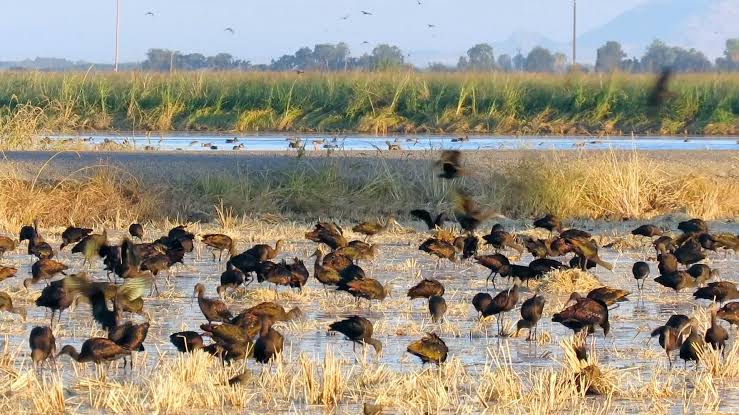
After California farmers harvest their rice crops, they need to get rid of the leftover rice straw. Burning it is cheap but illegal since it pollutes the air. Tilling the straw into the soil is expensive. Fortunately, farmers can enlist of help of wintering waterfowl. By foraging for leftover grain, weeds and bugs in the flooded fields, ducks and other birds help decompose the straw. This reduces the need to till the fields provides a considerable savings for the farmer.
They poop.

Seabird guano is rich in nitrogen, phosphorus and other nutrients providing an important source of fertilizer and income for many people living near sea bird colonies. Guano was
considered essential to the Incas’ agriculture. It seems the best Peruvian guano was 33 times more effective as barnyard manure based on its nitrogen content. Unfortunately, guano production is one of the most threatened avian eco-system services, due to the rapid decline of seabirds.
They are health providers.

The COVID pandemic revealed a ‘new’ service that most birders already knew about. Birds provide mental health services. Since the pandemic a myriad of research articles have appeared extolling the mental health benefits of watching birds. It helps reduce stress by slowing us down. It supposed increases our ‘brain’ power because we use multiple senses. Just hearing bird song can have healthful benefits. Who knew? Folks who watch birds knew!
They entertain.
Watching an adult bird feed its young, squabbles at the birdfeeder, a hawk hunting prey over a field, or a duck taking a bath in a puddle are more entertaining than anything you can find on TV. Watching birds is like having your very own reality show. And it’s definitely not scripted, you never know what you are going to see. And it’s free!
Let’s face it, birds do provide services that can be quantified but that’s not why we love them. We have all been transfixed simply by watching a bird flying; been lifted out of ourselves and felt our hearts race at the flash of wings. Everyone of us has seen what really matters – seen it in the blistering stoop of a falcon; heard it in the rich, harmonic song of a thrush, caught its essence in the slow undulations of white pelicans again the blue sky. And we realize in those moments, we are privileged to experience something beyond ourselves – that older, greater, glorious world that a wild bird inhabits. A world we can only catch glimpses of, but are grateful that it exists.
Comments